What if we asked a different question for homeschooling? How about: What do I want my child to remember about learning this year?
At the beginning of a homeschool year, there are so many questions to answer.
What curriculum are we using?
How do I keep track of all of this?
Are we doing enough?
What If We Asked a Different Question for Homeschooling?
But there’s another question I want to encourage you to ask, one that looking back, I can see matters more than all the rest:
What do I want my child to remember about learning this year?
Not what do I want them to memorize or which pages in the workbook do I want them to complete.
What do I want them to remember?
Maybe it’s the historical figure who fascinated them so much that they checked out every book the library had, or when they finally understood multiplication as a concept rather than simply memorizing the answer.
Maybe it’s the conversation that started during a lesson and somehow continued through lunch.
It’s moments like these that remind me why the way we learn matters just as much as what we learn.
We’re helping our children become people who know how to learn.
People who ask questions and make connections, who know what to do when they want to understand something more deeply.
We don’t have to chop the world into little disconnected subjects. We can give our children the opportunity to immerse themselves in something, explore it from different directions, and discover how all those pieces fit together.
So as you’re settling into your homeschool rhythm this September, maybe add one more question to your list:
What do I hope they’ll remember?
Let the answer shape what you do next.
Let the adventure begin,
Tricia (and Amanda)
P.S. One more veteran mom note of encouragement – Don’t worry if you don’t complete every possible activity along the way! Our unit studies are designed to be customized for your family so you can take what you want and leave the rest. What matters most is the learning happening in front of you.
One of the biggest misconceptions about homeschooling is that you need to know everything before you can teach it.
That you need to remember all the history.
Understand all the science.
Know exactly how to explain every math problem.
Have an answer ready for every question your kids might ask.
You Don’t Have To Be An Expert To Homeschool
But here’s something I’ve learned first hand over the years:
You don’t have to be an expert to successfully homeschool your kids!
In fact, some of our very best homeschool experiences have started with me saying, “I have no idea. Let’s find out.”
You’re Allowed to Learn Alongside Them
One of the things I love most about unit studies is how they can take some of the pressure off of us as parents. You don’t have to lecture your way through a subject or pretend you remember everything you learned in school.
Instead, you get to explore it together.
Sometimes I think we put an impossible amount of pressure on ourselves as homeschool parents. We assume that because we are responsible for our children’s education, we’re also supposed to personally possess all the information they’ll ever need.
But that’s not really what teaching looks like.
I think our job is to help our kids ask questions, find answers, make connections, and discover that learning is something they can do for themselves.
You don’t need to know where every question will lead before you begin. In fact, the way I see it now, curiosity is part of the learning.
We can grab a topic that sparks our kids’ interest and explore it through books, videos, hands-on activities, art, science, history, geography, and whatever interesting detours happen along the way.
So if you’ve ever worried that you aren’t qualified enough, knowledgeable enough, or “expert” enough to homeschool, remember this:
I just need to figure out what we’re doing for school.
Homeschool planning always starts for me with that simple thought.
Then, suddenly I’m planning history over here, looking at science options over there, finding books for reading, coming up with writing assignments, searching Pinterest for a hands-on project… and trying to remember which child needs what.
Before long, planning for learning in our homeschool can feel like it is taking more time than actually homeschooling!
Simplifying Homeschool Planning with Unit Studies
One of my favorite things about unit studies is how much they can simplify all of that.
Instead of planning every subject separately, we begin with one topic.
With a unit study in our homeschool, science was learning about marine animals and ecosystems. Geography was exploring the world’s oceans with our atlas and creating our own maps. History allowed us to learn all about explorers and the historic dangers of sailing around the world. Reading and writing naturally become part of the study, too with Treasure Island and Call it Courage.
One topic. So many opportunities to learn.
And if you’re homeschooling more than one child, it gets even better.
Everyone can explore the same topic together, while assignments are adjusted for different ages and abilities.
That means fewer separate lessons for you to organize and a lot more learning to actually enjoy together!
Less Planning. More Learning.
I think sometimes we assume that creating a rich homeschool experience requires hours and hours of preparation.
It really doesn’t.
Our Unit Studies are designed to give you the structure you need while still leaving plenty of room to make each study your own.
These kids activities on the concept of time will help your children explore timelines and see how history, art and more are woven together!
I have noticed that children can learn so much about things that they are interested in. They remember every small detail about the fish they caught and helped Dad clean. They remember with clarity the time they toured the Corvette factory and can share their adventure to the last detail with anyone who asks. They can name the stars and major constellations after spending nights in the backyard with Mom or Dad and a telescope. While investigating an interest in baseball, they can tell you all about Babe Ruth, Satchel Paige, Hank Aaron, and more, but they can’t necessarily tell you the years that they played.
With my own crew, I learned that there was an age or level of development where they could begin to put things in order time-wise—they could understand the concept of the American Revolution coming before the Civil War, for example. Before they reached this point, their interests were more pressing in their minds than the order in which things happened.
Kids Activities for Exploring the Concept of Time
To help your children begin to understand the concept of time, timelines are invaluable.
For example, the study of baseball started our study of the Civil War, as we discovered that the game was spread from north to south in prison camps during that conflict. While they were fascinated with baseball/softball at the moment, the Civil War caught their interest—what it was, why Americans were fighting Americans, etc.
While working on Gardens, we discovered that Gregor Mendel (the father of genetics who used sweet pea plants for his studies) worked on his research across the Atlantic Ocean during the Civil War and had his paper presented to the European scientific community in 1866, right after the end of the Civil War.
All of this to say that sometimes the interest they are following can reveal other areas of interest that become a fascination. I quickly learned that it is more fruitful to follow that interest, pointing out connections to other things that have been studied. It is helpful to have them create timelines as the study progresses, so they can see the overlaps—Mendel’s work, baseball, the Civil War, etc.
I’ve noticed that this gives them a framework on which they can “hang” the information. They also can see that nothing happens that is just science or history or art. God weaves events together in such amazing ways.
The timeline also helps them learn that events are happening all over the world simultaneously. In 1862, in the middle of the Civil War, President Lincoln signed the bill authorizing the building of the Transcontinental Railroad (Trains). In 1863, the first section of London’s Underground Railway opened. Also in 1863, both Henry Ford and Henry Royce were born, to later become leaders in the development of the automobile.
I have an analogy that helps me understand a child’s mind: A child’s mind is similar to the storage area on the top of an old-fashioned rolltop desk. There are all kinds of cubbyholes and nooks and crannies to be filled. When children are young, they can put all kinds of things in those compartments and know all about each one. They know just where each morsel is, and know just how it relates to other pieces (baseball to Civil War to trains). As they grow older, they begin to sort and arrange the information in the desktop, based on time, interest, etc.
So there you have my theory about kids and interests and their concept of time. But who am I to tell you that? You know firsthand that they don’t understand the concept of wait, or not right now, or just a few more minutes! 🙂
Independence Day is a wonderful opportunity to combine history, hands-on learning, and family traditions. If you’d like to explore the stories behind the 4th of July together, our Independence Day unit study will help you and your family celebrate.
The Fourth of July is just around the corner.
For many of us, it means cookouts, sparklers, parades, and staying up a little too late to watch fireworks light up the sky. It’s one of those holidays that brings families together almost effortlessly.
But somewhere between the hot dogs, red-white-and-blue decorations, and backyard celebrations, there’s also an opportunity to slow down and encourage your child’s natural curiosity.
Who were the people who signed the Declaration of Independence?
What risks did they take?
What did freedom mean to them?
And why do we still celebrate these events 250 years later?
The Stories Behind the Fourth of July
It has always amazed me how naturally curious our children are about these questions, especially when they begin to realize that history is really the story of real people who lived, struggled, and made difficult decisions.
In fact, we created our Independence Day unit study to help families explore those stories together. Throughout the study, learners discover the history behind the 4th of July while learning about Thomas Jefferson, John Hancock, and other patriotic figures who helped shape our nation.
More Patriotic Unit Studies for Homeschool
It’s time to get out the red, white, and blue, and get ready for some patriotic celebrations!
You probably know what it means to be patriotic, but do your children? Designed to spend one week on each holiday, this unique and interactive study covers these American patriotic celebrations for grades K-12
As you study together, they also build a lapbook filled with reminders of what they have learned (something you can return to in your homeschool long after the fireworks have faded).
With unit studies, you have a very powerful tool to build a strong tree of knowledge for your children. Your homeschool curriculum can be a shaping tool!
Empowering, enlivening, energizing – all words that bring to mind a sense of power and energy – invigorating. The power of homeschooling is all of that and more for our generation as parents, the generations that we are teaching, and many yet to be born. I don’t know about you, but homeschooling gave this small-town girl the confidence to think independently, not follow the crowd, and to speak up.
While learning to think and wonder and not conform to an ever-changing society, a funny thing happened along the trail of homeschooling – the children learned these lessons, too! From veterinary college to mock trial championships, our children have been empowered by homeschooling, right along with their parents.
I used to be a typical working mom, employed outside the home, struggling to find any time to catch my breath, while juggling schedules, family demands, finances, and dreams of retirement. With the switch to the amazing position of homeschool mom, I discovered both the rewards and fascination of following our interests, from studying the stars to tracking the ocean tides, from planting a vegetable garden to learning to cook, from following the routes of the explorers to tracking the paths of the men that walked on moon, from learning to quilt like the pioneers to learning how to build a fire, and so much more. No one ever made learning “interesting” for me when I was a child, but I’ve discovered that this is a powerful gift that I can give our children on a daily basis – a gift that will keep on giving for the rest of their lives.
How Your Homeschool Curriculum Can Be A Shaping Tool
In the beginning, homeschooling was a nerve wracking choice – am I doing the right thing, what will I teach them, what books shall we use, will they be able to get into college, and on and on. Then, through trial and error, we hit upon unit studies – and the light turned on, and away we went. The choice of homeschooling is a wonderful choice to make for many families, and the combined power of learning and following interests together is a life-changing force.
First, let me tell you just a bit of my story. We began homeschooling in the middle of a school year, so we chose to keep using the textbooks that the children had been using in school. That was an easy enough decision, but it quickly became obvious that they were well-trained in the use of textbooks – they read for bolded and italicized words, answered the questions at the end of the chapter, and memorized just well enough to take the test. There was no interest in schoolwork other than getting it done – no joy and certainly no curiosity.
Another problem that I became painfully aware of was that there was not much long-term retention of the material covered in the textbooks. Rote memorization of textbook material is no replacement for thinking skills and logic when it comes to leading a satisfying and fulfilling adult life. If the knowledge isn’t there to stay, there is no foundation or framework to build on for the rest of their lives. For example, if they memorize the names of the parts of a plant, but never get to take one apart and experiment with the pieces, studying them under a magnifying glass or microscope, how will the controversy of genetically engineered crops ever begin to make sense? If the framework isn’t there, the new information isn’t connected to anything, and it is difficult to use new information in a meaningful way.
With unit studies, we found a very powerful tool that has helped build a strong tree of knowledge for our children. Remember, your curriculum should be a shaping tool, NOT a vice grip. In my opinion, the strength of a unit study approach is that the student looks at a topic from all different directions. For example, when studying gardens, we look at the basics of plant science, the history of gardens, the gardens around the world, the art of Monet and other artists who were famous for their garden paintings, and much more.
How Unit Studies Can Make a Difference in Your Homeschool
To show the difference in textbook learning and unit studies, realize that nothing ever occurs in the vacuum of just being a historical, geographical or scientific event. When something happens, it happens in a particular place (geography), at a particular time (history), involving certain people (biographies), and has an impact on life in many ways (art, science, economics, etc).
However, when using a history textbook, events are presented chronologically, in a somewhat condensed and dry format. When we read about the first American landing on the moon, the typical history textbook will not include any information about the exciting scientific discoveries that were made to achieve this great feat. In this same textbook, we probably would not read about the astronauts and their individual contributions and sacrifices. The textbooks usually won’t include the thrilling descriptions of all that has been gained from putting a man on the moon – from the world of computers to the amazing breakthroughs in medicine. These exciting and interlinked accomplishments aren’t typically included in the brief paragraph on the American space program.
See what we would have missed if we had relied on a typical history textbook to learn about the space program? And yet these missing pieces are the ones that open up the world to our children, and show them how to dream big dreams and understand how all things work together.
Unit studies for middle and high school invite students to move beyond simply completing assignments and into engaging with ideas.
At some point, almost every homeschool parent I know (including me!) has asked the question:
“But what about high school?”
Can unit studies prepare students for high school?
It’s one thing to embrace creative, connected learning in the early years. But when transcripts, credits, and college preparation come into view, everything can start to feel more serious.
We worry that it has to be more structured, more traditional and rigid.
It’s understandable.
We want to make sure our children are truly prepared for what comes next. So it makes sense that we would also ask how unit studies fit into a high school homeschool.
Are unit studies academically rigorous?
Here’s what I have learned first hand and what I want you to know:
Unit studies don’t water down a high school education. They deepen it.
When done well, a unit study approach at the high school level invites students to move beyond simply completing assignments and into engaging with ideas.
Do unit studies meet homeschool requirements?
Instead of memorizing information for a test, students begin to:
Analyze complex topics
Evaluate different perspectives
Make connections across disciplines
Communicate their thinking clearly
Unit Studies for Middle and High School
This is the kind of learning that colleges, careers, and life actually require.
Consider this…
A traditional approach might cover history, literature, and writing as separate subjects. A unit study brings them together.
Are unit studies suitable for college-bound students?
It is not less rigorous, but it is more integrated and often more meaningful and lasting.
In fact, many homeschool families find that unit studies create stronger transcripts through rich, project-based work and can better prepare students for college-level expectations.
At this stage with unit studies for middle and high school, the goal isn’t just covering material. It’s developing a confident learner with strong critical thinking skills. And that’s exactly what a well-designed unit study helps cultivate.
Tricia (and Amanda) P.S. If you are nervous about the high school years, please, let me reassure you… Some of the most meaningful moments of our homeschool years happened in high school. You have so much to look forward to!
Here is how unit studies can help discover your child’s gifts and talents. Unit studies help us to help them discover their own gifts and talents, as they learn about the world while we are right there beside them.
First and foremost, remember that every child is a blessing, uniquely gifted by God. I’ll never forget the time that the chemistry experiment blew silver nitrate all over my brand new white curtains, and just how our daughter looked when it happened! I will never forget the thrill of the kids when they met some of the astronauts in person, and heard about some of their space adventures.
To use unit studies is to begin a trail of discovery for both you AND your children – a powerful journey of discovery.- Amanda Bennett
How Unit Studies Can Help Discover Your Child’s Gifts and Talents
Give your children a chance to follow their interests and you might just be surprised at the outcome. With unit studies, our children have obtained a better understanding of the way things work, the history of the world, their own abilities, and much more. I am always asked about “holes in their education” if unit studies are used. First, I ask the audience if anyone ever remembers completely finishing a textbook when they were a child – not many hands have ever been raised. I share my personal experience that we never finished a textbook when I was a child, and I was so disappointed – the “good” stuff was always toward the end of the book!
The concept of education is not just to fill their heads up with any and all information available – that would take hundreds of years in these days of ever-expanding information. The concept of a good education, in my opinion, is teaching the child to be able to think, to help them build a sound foundation of learning – a strong tree of knowledge where they can place more information over the course of their lives. I will never be able to teach my children about all things, BUT, I will teach them how to think, to investigate, to research and dig for answers. In the years ahead, it is my opinion that this will be a priceless education for those who will be successful in a rapidly changing world.
Unit studies can do just this, and that’s my intention when I write them and use them – getting the child to think and explore, letting curiosity get the best of them. Try to help them develop a love of learning and enjoy the wonder of the world – it’s quite an empowering accomplishment. As powerful as homeschooling can be, it is not a result of all homeschooling families being just alike. Realize that you will never be “just like” other families in your homeschool group or those at your state convention.
I’ve traveled all over the country as a speaker at homeschool conferences, and I’ve met all kinds of people. I am frequently asked by many parents, “Are we like typical homeschoolers?” I have to smile at this point – I don’t think I’ve ever met a “typical” homeschooler. That would be like having a “normal” day of homeschooling, whatever that is. Enjoy the uniqueness of your family and your approach to homeschooling. Some families use textbooks, while others use unit studies. It isn’t as important to follow the crowd anymore, now that the crowd is just you and your clan – what a blessing this is for all of us.
Our family has done so many things since we started homeschooling – we’ve traveled all over, met some amazing people, and followed our dreams to all kinds of places, and I can honestly say that we’ve never had a boring day – and certainly not a “normal” day, and that is not our goal.
As a former corporate engineer, I am well-aware of the concept of having goals and a mission statement. What is my mission statement these days? To help the children discover their own gifts and talents, whether in botany or veterinary science, athletics or orthodontics, who knows what the future holds! Now, as a homeschooling mom, what is my goal? To work myself out of a job by helping them become self-motivated learners – to have them out there, learning and challenging and thriving within the realm of their own very unique gifts and talents.
What is interest directed learning and how can you use it to help your homeschoolers grow and develop their special gifts and talents?
Interest-Directed Learning: What Is It?
You hear so much about interest-directed learning these days, don’t you? At our house, we used unit studies based on the interests of our children. I started out on my challenge of following their interests to discover their gifts and talents. Since I was fairly new to homeschooling and still learning how each child is so unique, it took a bit of creative thinking to figure out just exactly what their interests were and how I could capture the ideas and help them grow and developtheirspecial gifts and talents.
I learned to be a better observer of their favorite things to do, their curiosity statements, their tendencies to favor different topics in the library, and so on. Try it out. Make a simple chart of ideas based on things you see in the weeks ahead. Here are a few examples:
Area of interest: Possible life work
Serving others: Pastor, missionary, service organizations, church service
Following clues, putting puzzles together: Detective, food scientist, astrophysicist
History fanatic: Ambassador, politician, leader, professor
Working with their hands: Electrician, finish carpenter, orthopedic surgeon
Working with animals: Zookeeper, veterinarian, zoologist
Working with a camera: Photographer, biologist, scientist, satellite designer
These are just a few ideas and connections that can be made with some of the interests that children display. Make a file on your phone or keep a small notebook handy so that you can record their interests that just happen to pop up—a mention of wanting to know how a lawn mower works to wishing she knew how to sew. By keeping track of these, you’ve got some concrete things to pursue, and you know what to watch for at the next library or garage sale. Enjoy the off-road explorations. They are learning ALL the time!
Spring has a way of making everything feel fresh again. Enjoy a fresh start for your homeschool this spring!
The days grow longer, the air warms up, and suddenly it feels like the perfect time to shake things up a little in our homeschools. If your routine has started to feel a bit stale after the long winter months, a simple spring refresh can bring new energy and curiosity back into your learning days.
And the good news? It doesn’t require a complete overhaul.
Sometimes the smallest changes make the biggest difference in our homeschools. A new topic to explore, a fresh question to investigate, or a hands-on project can spark excitement again for both you and your kids.
That’s exactly why we’re so excited to share three brand new unit studies with you this spring!
New Unit Studies Just In Time For Spring
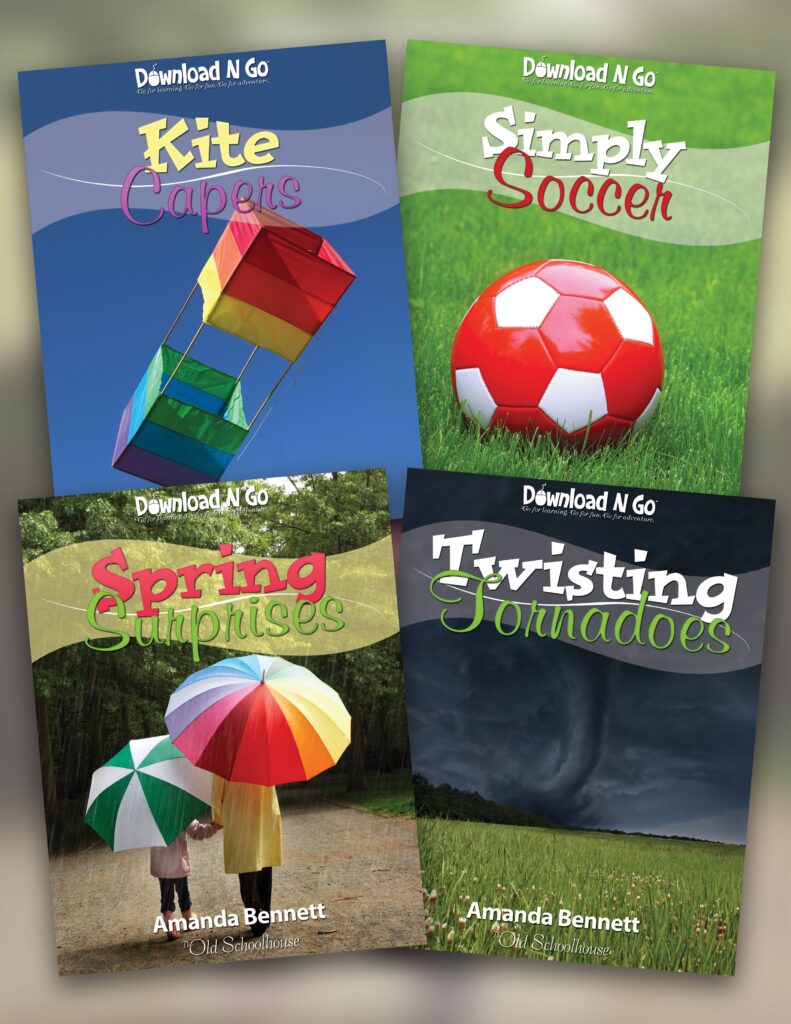
🌸 Spring Study Bundle: Spring is bursting with fascinating discoveries—from the science of blooming plants to the surprising ways animals and ecosystems change with the season. This study invites your kids to explore the wonders of spring through our Spring Surprises, Twisting Tornadoes, Simply Soccer and Kite Capers units.
⚽ Simply Soccer: Perfect for sports-loving learners, this unit study dives into the history, science, strategy, and global culture of soccer. It’s a fun way to connect learning with an activity many kids already love.
🪁 Kite Capers: Few things feel more like spring than watching a kite soar through the sky. In this study, students explore the science of flight, the history of kites around the world, and the creativity behind designing and flying their own.
Each study is designed the UnitStudy.com way, the way we teach our own children, with one topic explored together across multiple ages while encouraging curiosity, conversation, and deeper understanding.